Armenia’s Window of Opportunity: Normalization with Türkiye
Turning diplomatic momentum into an open border and durable bilateral relations
Read the full article
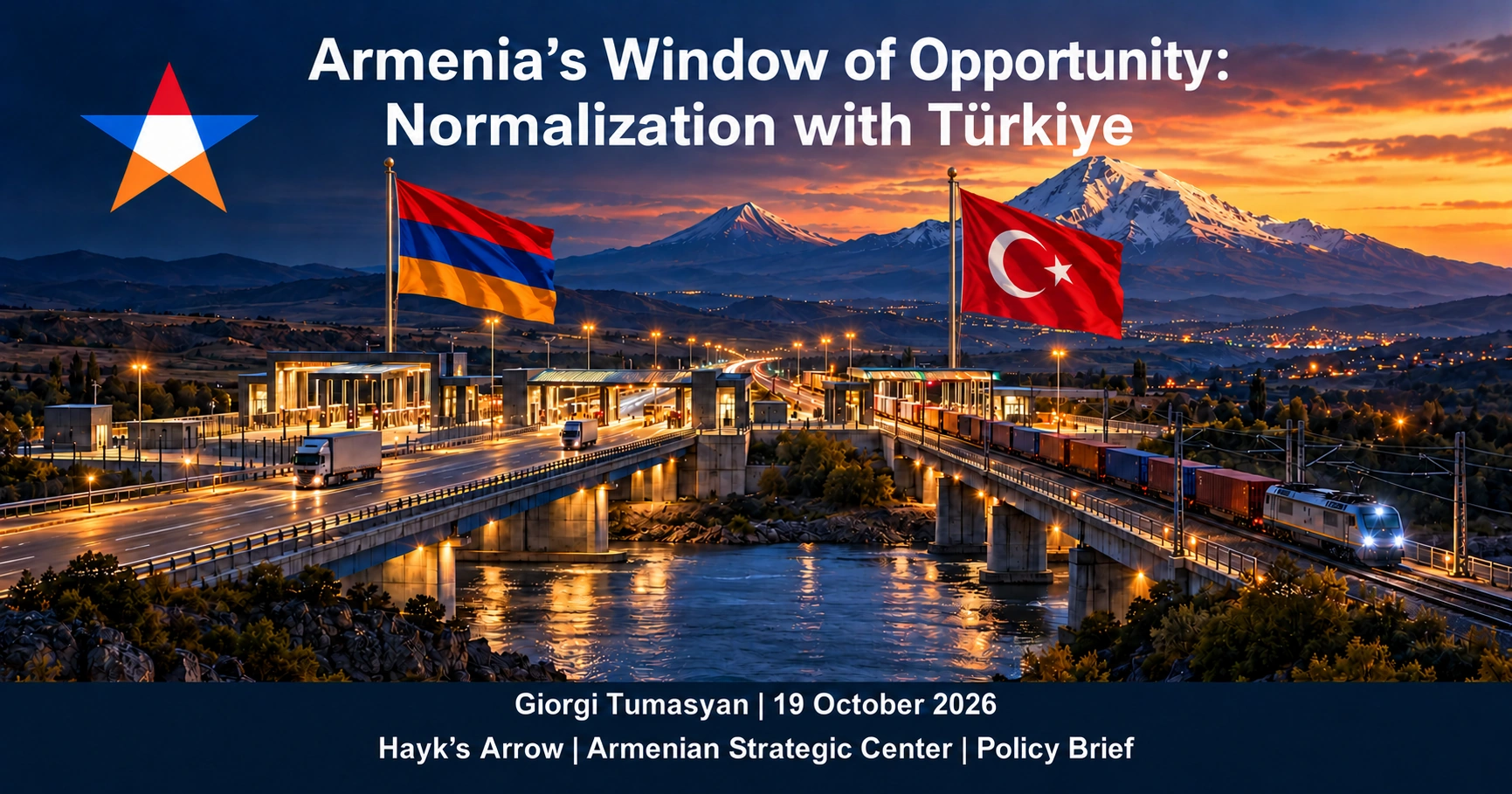
Armenia should pursue an accelerated, practical agreement with Türkiye on opening the land border and establishing diplomatic relations. Recent bilateral progress and public disagreements between Ankara and Baku create an opportunity to test how far Türkiye is prepared to advance normalization on its own merits.
A process with substance—but an unfinished core
That opportunity requires disciplined diplomacy. Armenia should build its approach around Türkiye’s identifiable interests and existing commitments, while treating the durability of the Turkish–Azerbaijani alliance as a continuing security consideration. The immediate objective should be a jointly agreed implementation timetable, beginning with commitments already made and leading toward full normalization.
The present opening rests on developments that preceded the October tensions between Türkiye and Azerbaijan. In September 2025, the Armenian and Turkish special representatives agreed to accelerate implementation of their earlier border-crossing agreement and undertake technical studies concerning the Gyumri–Kars railway and electricity interconnection. They also reaffirmed that normalization would proceed without preconditions. A joint railway working group subsequently met in Kars in April 2026. These steps established a practical agenda, although technical discussions alone do not constitute an operational transport connection.
In May 2026, the two countries signed a protocol on jointly restoring the historic Ani Bridge. In September, Nikol Pashinyan and Recep Tayyip Erdoğan discussed implementing existing agreements, strengthening business connections and unblocking regional transport links. These developments demonstrate that normalization has acquired a broader institutional and economic foundation.
Nevertheless, the distinction between progress and completion remains essential. Türkiye’s May 2026 announcement on direct trade allowed goods transported through third countries to identify Armenia or Türkiye as their origin or final destination. It did not open the shared land border.
On 13 October, Ararat Mirzoyan described the normalization process as considerably matured while explicitly acknowledging that the border remained closed. His optimism was a political assessment, not an announcement of an agreed opening date.
What the Ankara–Baku dispute changes
The October dispute has exposed differences over sovereignty, political influence and the limits of solidarity between Türkiye and Azerbaijan. In its 13 October statement, Azerbaijan’s ruling New Azerbaijan Party directly criticized figures associated with Türkiye’s governing party, defended Azerbaijan’s relations with Israel and rejected interference in domestic affairs. The disagreement therefore extends beyond exchanges between individual commentators.
It would, however, be premature to interpret this as a strategic rupture. On 15 October, Hakan Fidan acknowledged differences in approach while emphasizing the strength of bilateral relations and the leaderships’ determination to protect them.
For Armenia, the useful inference is narrower: Ankara and Baku have distinct interests, even within a close alliance. Armenian diplomacy should explore the room those differences create for bilateral decisions. It should avoid presenting normalization as an attempt to turn Türkiye against Azerbaijan, which would give opponents an additional argument for obstructing the process.
Make normalization serve identifiable Turkish interests
Armenia’s strongest diplomatic proposition is a practical one: functioning relations would give both countries a more predictable neighbourhood and additional opportunities for trade, transport and regional cooperation.
Recent Turkish messaging provides a basis for advancing that proposition. Speaking at Armenia’s Independence Day reception in Istanbul, Deputy Foreign Minister Berris Ekinci described normalization as a bilateral process and highlighted steps in transport, energy, culture and direct trade. This language offers an opening for specific proposals, although it does not establish that Ankara has abandoned its wider regional calculations.
Armenia should consequently present border opening as the implementation of a shared bilateral agenda. Regional peace and transport projects can reinforce that agenda, while each practical Armenian–Turkish measure should have its own justification, responsible institutions and timetable.
Armenia’s priorities
Seek a dated implementation agreement. The first priority should be implementing the July 2022 agreement permitting land-border crossings by third-country citizens. Armenia should propose a specific commencement date, published eligibility rules, operating hours and a mechanism for resolving problems. This limited opening should be an initial stage toward access for Armenian and Turkish citizens and regular freight traffic.
Prepare the procedures that make an open border usable. Customs clearance, transport permits, insurance, sanitary controls and payment arrangements require coordinated preparation. The October meeting between Armenian and Turkish ministers already included discussion of goods subject to sanitary and veterinary controls. Armenia should turn such contacts into an operational checklist developed with exporters and transport companies.
Advance diplomatic relations alongside connectivity. An open crossing would be valuable, but durable normalization also requires permanent channels for managing disputes and assisting citizens. Armenia should seek agreement on establishing diplomatic relations and the practical arrangements for representation, while continuing technical work on transport.
Protect sovereign authority in every connectivity arrangement. Armenia should insist on effective jurisdiction over its territory, border management, customs functions and infrastructure security. The published Armenia–United States TRIPP framework explicitly recognizes Armenian sovereignty and jurisdiction, including over border and customs operations. Implementation arrangements should be assessed against those commitments.
Prepare domestic businesses and preserve alternatives. Armenia should assess which sectors could benefit from new access and which could face adjustment pressures. Export assistance, competition oversight and support for affected smaller businesses should accompany opening. Relations and transport connections with Georgia and Iran should remain priorities, giving Armenia several functioning routes and reducing exposure to future interruptions.
Measure success by operation and durability
Armenia should propose a focused implementation programme for the next three months: a joint readiness assessment, a dated first-stage border-opening arrangement and a published sequence for expanding access. This is a recommended negotiating timetable, not a prediction that normalization can be completed within that period.
Progress should be measured through actual crossings, functioning customs procedures, reliable freight movement and institutional diplomatic contact. Railway studies and restoration projects should have identifiable milestones. Exceptional openings should develop into predictable access.
Normalization should also proceed alongside continued defence preparation. Armenia can pursue diplomatic relations, trade and reduced isolation while maintaining its historical positions, protecting Armenian cultural heritage and addressing unresolved security concerns.
The opportunity is to convert accumulated diplomatic progress into arrangements that expand Armenia’s choices. Ankara–Baku tensions may provide additional room for action, but Armenia’s strategy should remain useful even if those tensions subside. A functioning border and durable bilateral institutions would offer a more lasting gain than temporary disagreements between neighbouring powers.
Sources
- Armenian MFA · Special representatives, 12 September 2025 ↗
- Armenian MFA · Railway working group, 28 April 2026 ↗
- Prime Minister’s Office · Ani Bridge, 4 May 2026 ↗
- Prime Minister’s Office · New York meeting, 23 September 2026 ↗
- Turkish MFA · Direct trade, 13 May 2026 ↗
- Armenian MFA · Warsaw discussion, 14 October 2026 ↗
- New Azerbaijan Party · Statement, 13 October 2026 ↗
- Anadolu Agency · Fidan, 15 October 2026 ↗
- Public Radio of Armenia · Ekinci, 16 October 2026 ↗
- Armenian MFA · Border-crossing agreement, 1 July 2022 ↗
- Public Radio of Armenia · Trade procedures, 16 October 2026 ↗
- Armenian MFA · TRIPP framework, 26 May 2026 ↗